


Take a close look at a honeycomb.
Every tiny cell has exactly six sides.
Now think about snowflakes, some turtle shells, rock formations, and even certain engineering designs.
Why do so many things share the same shape?
Is it just a coincidence?
Not at all.
The answer involves geometry, efficiency, and one of the smartest designs found in both nature and engineering.
Let's discover why the hexagon is such an amazing shape.
What Is a Hexagon?
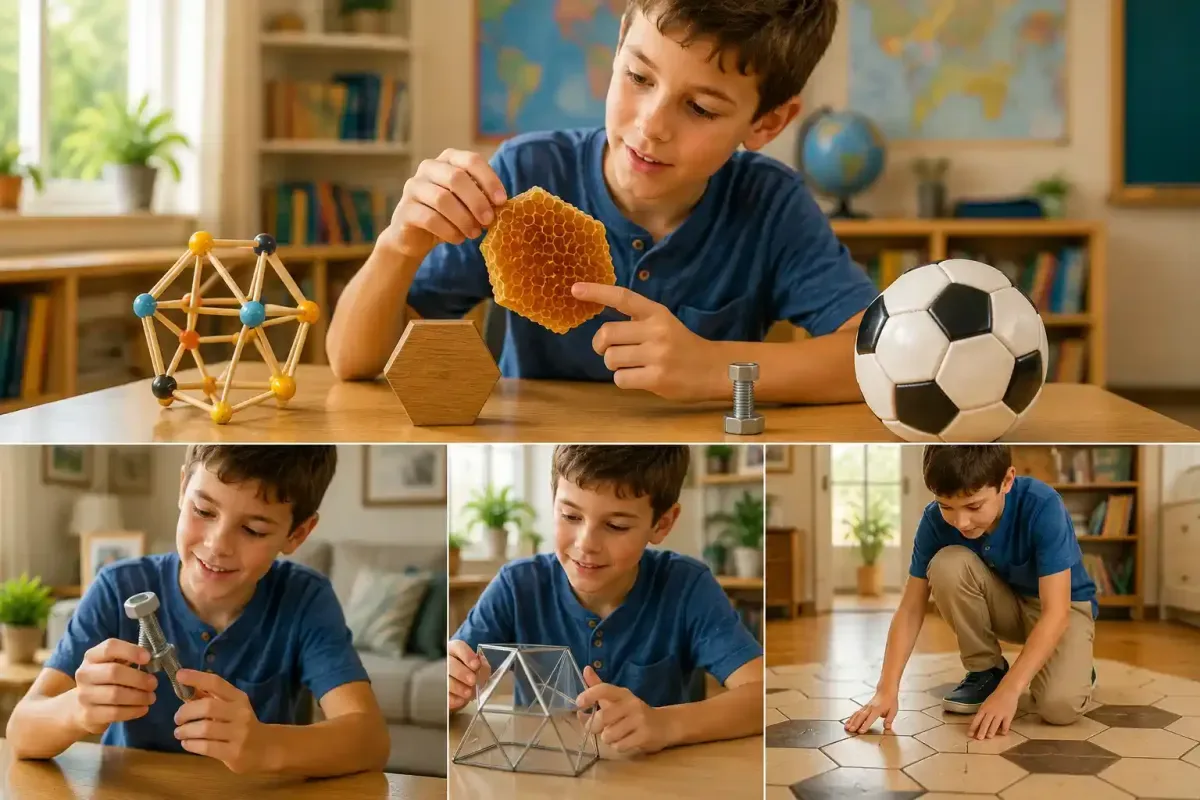
A hexagon is a shape with six sides and six corners.
Some hexagons have all sides the same length. These are called regular hexagons.
Others have sides of different lengths. These are called irregular hexagons.
Although they look different, both are still hexagons because they have six sides.
Hexagons appear in many places you may not expect.
You can find them in honeycombs, nuts and bolts, floor tiles, soccer ball patterns, and even pencils.
Once you begin looking, you will notice them almost everywhere.
Why Don't Bees Build Circles?
Imagine you are a bee building hundreds of tiny rooms for honey.
Would circles work?
Not very well.
If you place circles next to each other, empty spaces appear between them.
Those gaps waste valuable storage space.
Squares and triangles fit together without leaving gaps.
Hexagons do too.
Shapes that cover a surface completely without gaps are called tessellations.
A tessellation is a pattern made by repeating shapes that fit together perfectly.
Bees naturally build hexagons because they can store a large amount of honey while using less wax than many other shapes.
Scientists and mathematicians have studied this idea for hundreds of years and found that the hexagon is one of the most efficient designs in nature.
Try This Geometry Challenge

Take three sheets of paper.
Draw rows of circles on the first page.
Draw rows of squares on the second.
Draw rows of hexagons on the third.
Now compare them.
Which page has empty spaces?
Which page uses the available space most efficiently?
You have just investigated one of the same questions mathematicians and engineers study.
Making observations and testing ideas is an important part of mathematical thinking.
Why Do Engineers Use Hexagons?
Nature is not the only place where hexagons appear.
Engineers use them too.
Many airplanes contain lightweight honeycomb panels hidden inside their wings and floors.
These panels are incredibly strong without adding much weight.
That helps airplanes carry passengers while using less fuel.
Some bicycles, building materials, packaging, and protective equipment also use honeycomb designs because they combine strength with efficiency.
Instead of adding more material, engineers often choose smarter shapes.
Sometimes the strongest design is also the lightest.
Hexagons Hidden in Nature
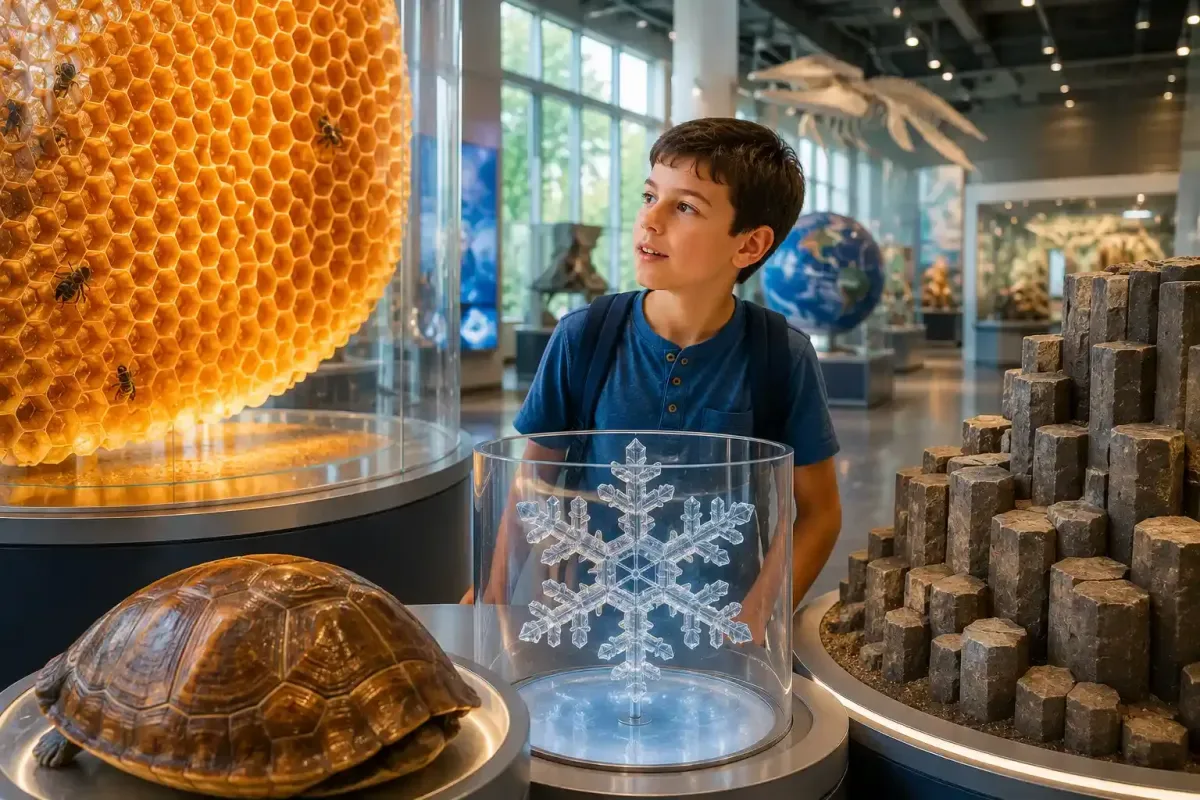
Look carefully and you will discover hexagons in surprising places.
Honeycombs are the most famous example.
Snowflakes often grow with six sides because of the way water molecules freeze.
Some turtle shells contain hexagonal patterns that help create strong protective coverings.
Certain volcanic rock formations form tall columns with six sided shapes after lava cools.
Nature often repeats patterns because they solve problems efficiently.
When something works well, nature tends to use it again and again.
Logic Puzzle
Only three regular shapes can cover a flat surface without leaving gaps.
They are:
- Triangle
- Square
- Hexagon
Which shape below cannot cover the floor by itself without leaving empty spaces?
A. Circle
B. Triangle
C. Square
D. Hexagon
Think carefully before checking the answer.
The correct answer is A. Circle.
Although circles roll beautifully, they leave empty spaces when placed next to one another.
That is why bees do not build circular honeycombs.
Become a Geometry Explorer

Now it is your turn.
Look around your home or classroom.
Can you find five hexagons?
Try searching for:
- Pencil
- Bolt heads
- Chicken wire
- Floor tiles
- Honeycomb patterns
- Soccer ball panels
You may discover that geometry has been quietly hiding around you all along.
Why Geometry Matters
Geometry is much more than drawing shapes on paper.
It helps explain how bees build their homes, why airplanes stay light and strong, and how engineers solve real world problems.
The next time you see a honeycomb, a snowflake, or a hexagonal bolt, remember that you are looking at one of nature's smartest designs.
Math is not only about solving equations.
It is about discovering the hidden patterns that make our world work.
Keep asking questions, keep exploring, and you may start seeing geometry everywhere.
Can You Remember?
Why do bees build hexagons instead of circles?
Great Job!
You reached the end of today's learning adventure!