


Have you ever looked at a piano and wondered why it has so many keys?
A modern piano usually has 88 keys. Some are white, and some are black. Together, they give musicians a huge range of sounds, from deep, powerful bass notes to bright, sparkling high notes.
But the keys themselves do not actually make the sound.
The real action happens inside the piano.
When you press a key, you are starting a tiny mechanical chain reaction that happens incredibly quickly.
Let's take a closer look.
What Happens When You Press a Piano Key?
Imagine pressing a single piano key.
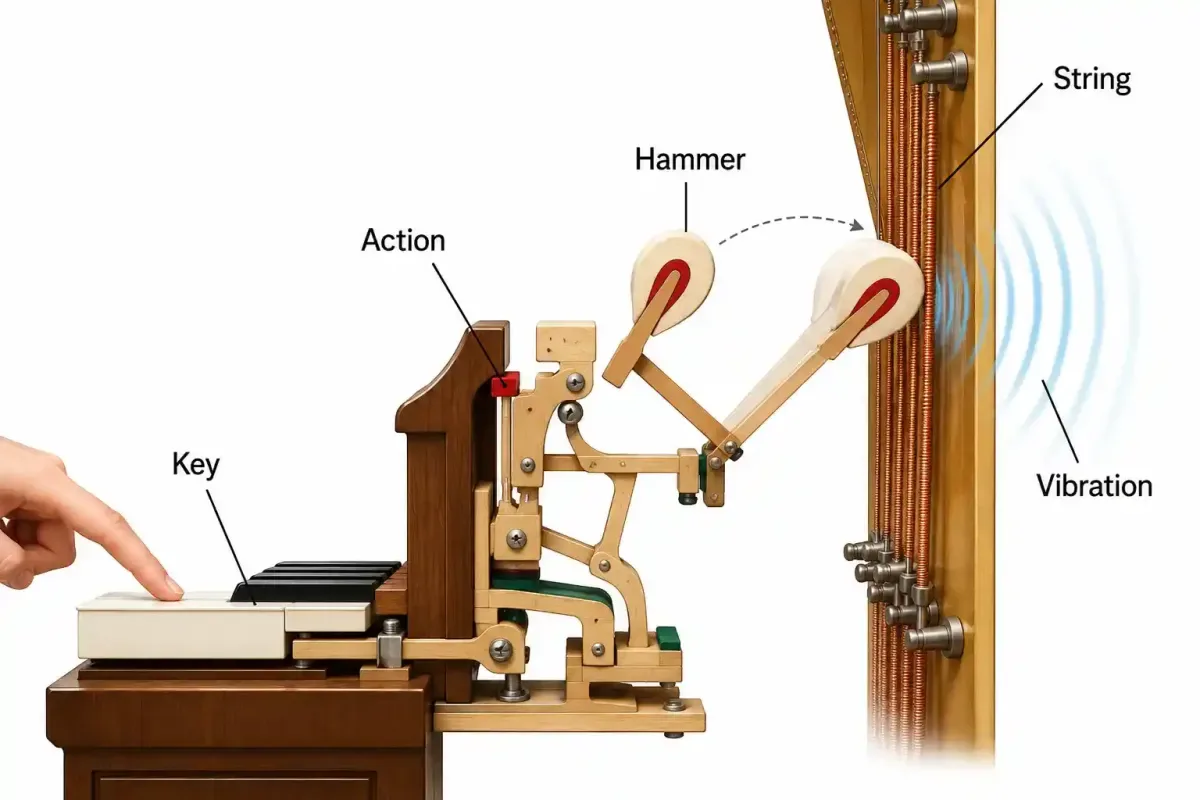
The key moves a series of small mechanical parts inside the instrument. Eventually, a felt covered hammer swings forward and strikes a tightly stretched string.
The hammer does not stay against the string. It quickly moves away so the string can continue vibrating.
That vibration creates the sound you hear.
So, in a way, playing the piano is like starting a tiny machine that turns the movement of your finger into music.
Why Do Piano Strings Make Different Notes?
If you look inside a piano, you will find many strings.
They are not all the same.
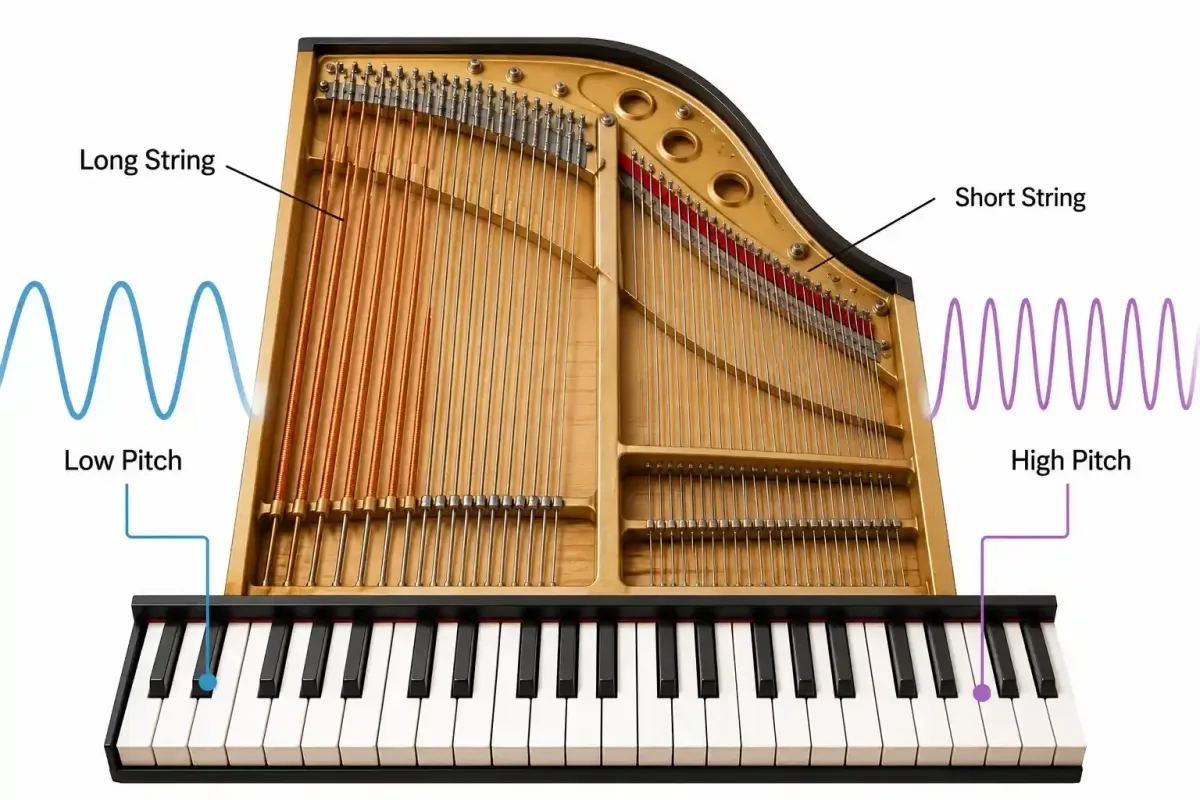
Some strings are longer and thicker. Others are shorter and thinner.
The strings are also stretched with different amounts of tension.
These differences affect how quickly the strings vibrate.
A string that vibrates more slowly produces a lower pitch.
A string that vibrates more quickly produces a higher pitch.
That is why the left side of a piano keyboard produces deep, low notes while the right side produces higher notes.
The piano's 88 keys cover a wide range of pitches, allowing musicians to play melodies, harmonies, and complex chords.
How Does a Piano Become Loud Enough to Fill a Room?
You might think the strings alone create the entire sound.
They don't.
The strings inside a piano are relatively quiet by themselves. The piano needs another important part to help make the sound stronger.
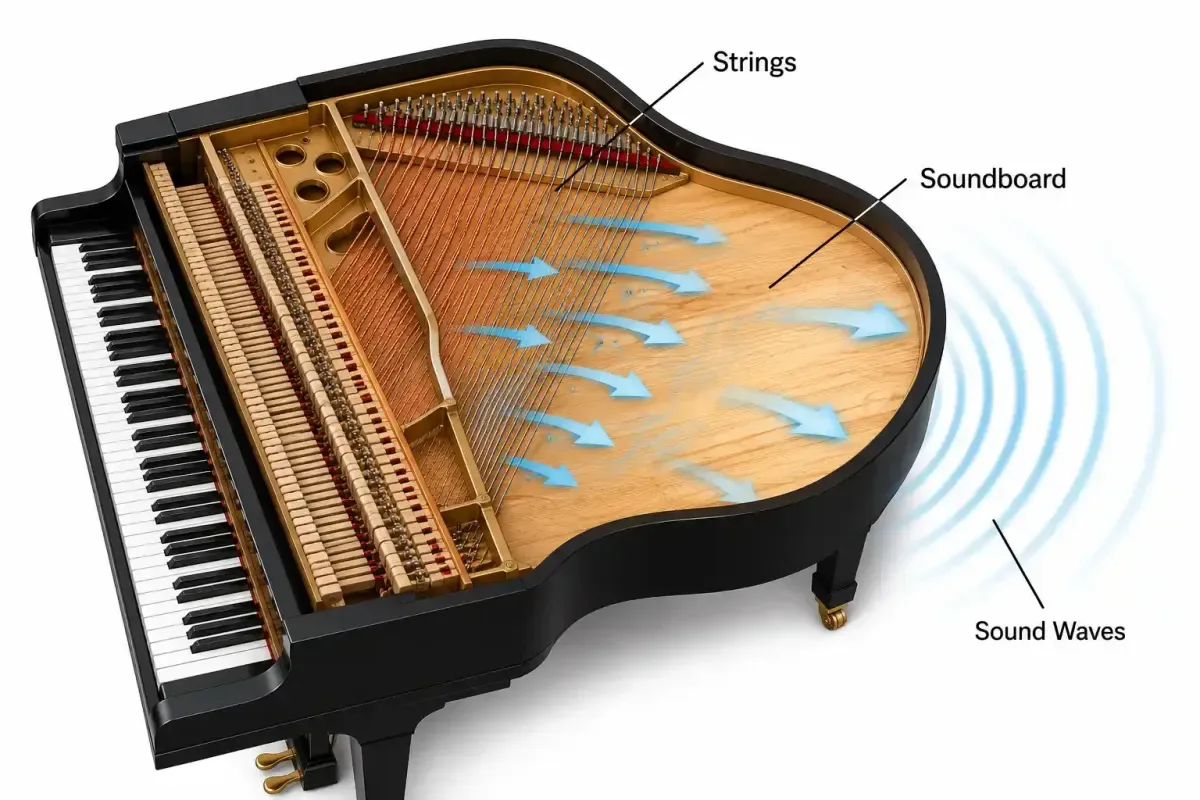
That part is the soundboard.
The soundboard is a large wooden surface inside the piano. When the strings vibrate, those vibrations are transferred to the soundboard.
The soundboard then vibrates and moves more air than the strings could move on their own.
This process helps amplify the sound so that people sitting across a room can hear the music.
The shape and construction of the piano also affect the way the sound travels.
This is one reason grand pianos can produce such a rich and powerful sound.
Why Can a Piano Play Softly or Loudly?
One of the most interesting things about a piano is that the musician can change the volume of a note.
Press a key gently, and the hammer hits the string with less energy.
Press it more firmly, and the hammer strikes with greater energy.
The result can be a softer or louder sound.
This gives pianists a huge amount of control over how music feels.
A quiet passage might sound calm, mysterious, or peaceful.
A powerful section might sound exciting, dramatic, or energetic.
The musician is not just playing the correct notes. They are also shaping the emotion of the music.

Where Did the Piano Come From?
The piano has a fascinating history.
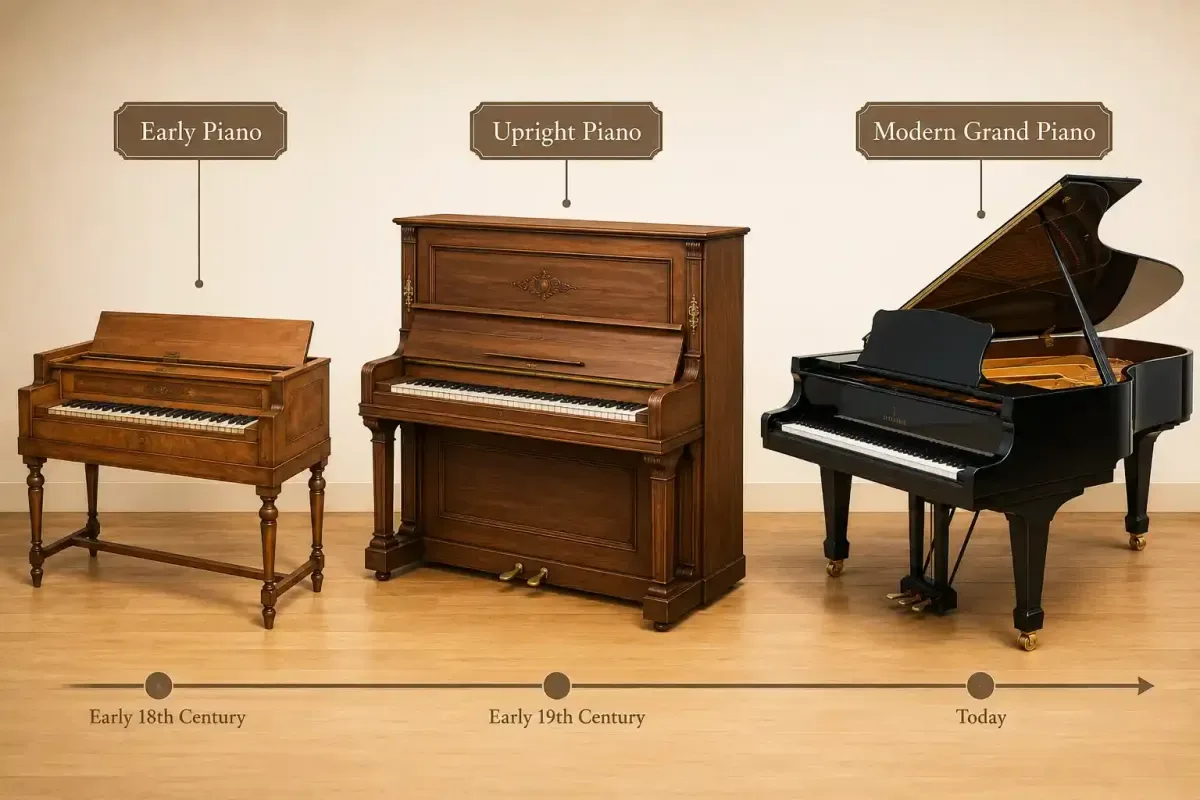
The modern piano developed from earlier keyboard instruments. One important inventor was Bartolomeo Cristofori, an Italian instrument maker who created an early version of the piano around the beginning of the 18th century.
His invention was special because musicians could control the volume of their notes by changing how strongly they pressed the keys.
Earlier keyboard instruments did not offer the same kind of control.
Over time, piano makers continued improving the instrument. They experimented with its design, materials, strings, frame, and keyboard until the modern piano became the powerful and expressive instrument we know today.
The piano eventually became an important part of classical music and later found its way into jazz, blues, rock, pop, film music, and countless other styles.
The Piano Is Music and Science Working Together
A piano may look like a beautiful piece of furniture, but inside it is also a fascinating machine.
When you press a key, mechanical parts move.
A hammer strikes a string.
The string vibrates.
The vibration travels through the instrument.
The soundboard helps amplify the sound.
Sound waves then travel through the air to your ears.
All of this happens in a fraction of a second.
The piano brings together music, physics, engineering, mathematics, and craftsmanship.
That is what makes instrument exploration so exciting. When you learn how an instrument works, you are not just learning about music. You are also discovering the science and technology hidden inside it.

Did You Know?
A modern piano usually has 88 keys, but not every piano in history had that many.
As composers began writing music that needed a wider range of notes, piano makers gradually expanded the keyboard.
Today, those 88 keys allow musicians to explore an enormous range of musical possibilities.
Try This Music Science Challenge
If you have access to a piano or keyboard, try playing the same note in two different ways.
First, press the key gently.
Then, press it more firmly.
Listen carefully.
Did the pitch change, or did the volume change?
Now try playing a low note and a high note.
Can you hear the difference in pitch?
Think about what is happening inside the instrument. The next time you hear a piano, remember that every note begins with movement and vibration.
Chiki Says
A piano is much more than a collection of black and white keys.
It is a carefully engineered instrument where mechanics, vibrations, materials, and human creativity work together.
The next time you hear a pianist play, listen beyond the melody.
Think about the tiny hammer moving inside.
Think about the strings vibrating.
Think about the soundboard carrying those vibrations into the room.
Every note you hear is the result of science turning movement into music.
And that is the amazing story hidden inside a piano.
Great Job!
You reached the end of today's learning adventure!